Sri Lankan Institute of Information Technology
An AI-powered pipeline to digitize, restore, and translate ancient Sri Lankan inscriptions from degraded stone surfaces.
Developed by: Lahiru Bandara, Amadhi Hansani, Senod Mesandu, Chamodya Handapangoda
Supervised by: Ms. Gaya Thamali Dassanayake, Mr. Samadhi Chathuranga Rathnayake, Ms. Sandaresee Priyathma Sudusinghe

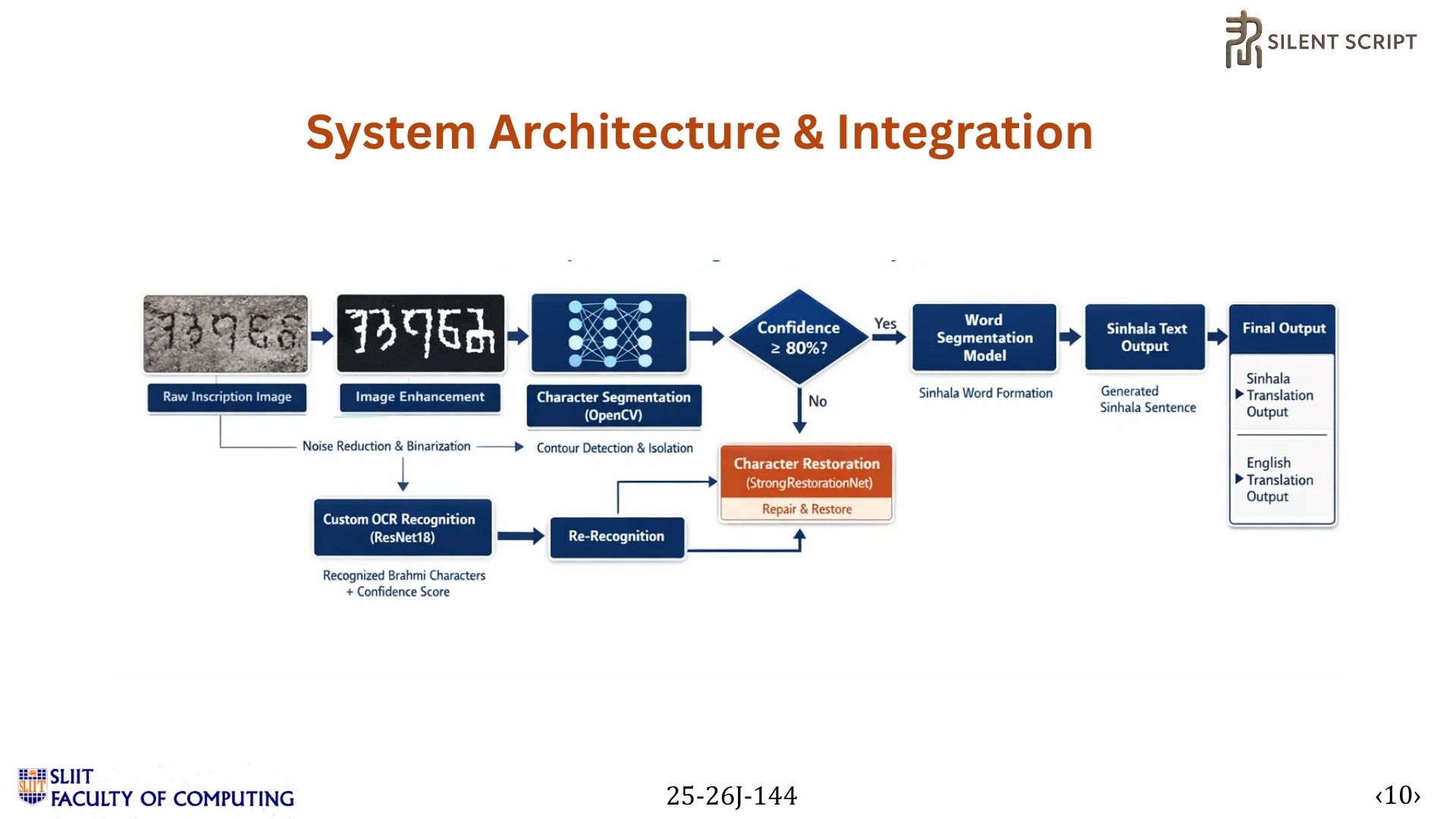
Silent Script introduces a novel deep-learning architecture designed to automate the epigraphical analysis of ancient Sri Lankan inscriptions. By combining image enhancement, instance segmentation, and neural machine translation, the system successfully digitizes heavily degraded stone texts where traditional OCR fails.
Preserving the rich history embedded in ancient stone inscriptions is a race against time. Natural weathering and human interference have left these artifacts severely degraded, making traditional preservation methods insufficient.
Meet the supervisors and researchers behind Silent Script. Feel free to reach out for collaborations or inquiries.
Primary Supervisor
Lecturer, Department of Information Technology, SLIIT
Machine Learning, Data Analytics, Big Data, Cloud Computing, AI
Co-Supervisor
Lecturer, Department of Computer Science, SLIIT
Machine Learning, Deep Learning, Data Science, NLP, Cyber Security
External Supervisor
Have a question or want to collaborate? Drop us a message below.
Advanced pre-processing using deep learning to remove noise, correct lighting, and highlight faint carvings on stone.
Generative models reconstruct missing or heavily weathered parts of characters, boosting readability from <20% to>90%.
Instance segmentation algorithms isolate individual lines and words from the continuous, often irregular ancient script.
Precise extraction of individual characters, handling overlapping and joined ancient letters.
A custom Improved U-Net architecture classifies ancient characters with 94.6% accuracy, mapping them to modern digital equivalents.
A specialized Neural Machine Translation model converts the recognized ancient syntax into modern readable text.
Custom convolutional neural network trained on a newly curated dataset of ancient scripts to achieve high-precision classification.
Lahiru BandaraGenerative Adversarial Networks (GANs) specialized in texture filtering and contrast enhancement for lithic surfaces.
Chamodya HandapangodaAn integrated pipeline using spacing detection and Transformer-based NLP models to decode and translate ancient syntax.
Amadhi HansaniInpainting algorithms utilizing contextual awareness to reconstruct eroded or broken characters based on surrounding text.
Senod Mesandu| Model | Precision | Recall | F1-Score | Accuracy |
|---|---|---|---|---|
| Baseline CNN | 0.82 | 0.80 | 0.81 | 81.5% |
| ResNet-50 | 0.89 | 0.88 | 0.88 | 88.2% |
| Improved U-Net (Ours) | 0.96 | 0.94 | 0.95 | 94.6% |
Real-time character recognition and restoration in action.
We express our deepest gratitude to the Department of Archaeology, Sri Lanka, for their invaluable support and for providing access to essential historical datasets. Special thanks to our primary supervisor Ms. Gaya Thamali Dassanayake, co-supervisor Mr. Samadhi Chathuranga Rathnayake, external supervisor Ms. Sandaresee Priyathma Sudusinghe, and the faculty at SLIIT for their continuous guidance and scholarly insights throughout this research project.